"Finance in a Changing World"
Interview with Andreas Fuster, Professor of Finance at the UZH Department of Finance on finance, technology, and the future of finance

As of 1 October 2026, Andreas Fuster holds the position of Professor of Finance at the UZH Department of Finance. His research focuses on household and real estate finance, banking, and macroeconomics, with a particular interest in how technological innovations are transforming credit markets.
Before joining the University of Zurich, Andreas Fuster was Associate Professor of Finance at EPFL and held positions in the Research Department of the Federal Reserve Bank of New York and in the Financial Stability Department of the Swiss National Bank, where he continues to serve as a part-time research advisor.
We spoke with Andreas about his research, the role of technology in finance, the connections between academic research and financial practice, and his plans for his new role at the University of Zurich.

Interview
Dear Andreas, welcome to our department! We would like to introduce you and your research to our community. To start, could you please share with us what initially drew you to household finance, banking, and real estate finance, and how your research has evolved since then?
I started my PhD in 2006. At that time, banking and real estate finance didn’t play much of a role in standard graduate courses, and I also wasn’t very interested in those topics – instead, I wanted to work on questions in behavioral and experimental economics.
The US housing bust and mortgage crisis that started in 2007 then changed my priorities. Along with everybody else, I wanted to better understand how housing and mortgage markets worked, what caused this mess, and how policy could help dampen the downturn. I was very lucky to get a research assistantship at the Boston Fed during my third year of graduate studies, where I worked with Paul Willen, one of the leading economists in this field. Working with Paul and the great data that the Fed already had back then got me started in this area.
After grad school, my first job was at the New York Fed, and it was very natural to keep working on these topics there, also given that the Fed continued to buy large quantities of mortgage-backed securities. So during my time there, I did research on the entire chain from borrower behavior to lender decisions, transmission through financial markets, and monetary policy implications.
I continue to be very interested in all of these aspects of credit markets, but my research now also covers bank funding and risk management, as well as household financial behavior beyond mortgages — closely connected to my original interests in behavioral economics.
Technological innovation is transforming financial markets and, increasingly, the way households’ access and use financial services. What changes do you find particularly interesting from a research perspective?
There are many important questions related to technological innovation in financial services, but one that I’ve been particularly interested in is how innovation affects the distribution of credit – i.e. who can get a loan, and at what cost. When lenders use new types of data or better statistical methods, including machine learning/AI, how does that change their assessment of different borrowers’ risk and profitability?
In a 2022 paper (https://onlinelibrary.wiley.com/doi/abs/10.1111/jofi.13090), my co-authors and I used US mortgage data to study how machine learning changes credit risk assessments. Our analysis suggested that more sophisticated credit risk models may have less favorable effects on Black and Hispanic borrowers than on White borrowers. So better prediction does not automatically mean that the benefits are shared equally.
At our recent Rising Scholars in Finance Conference 2026, you gave a keynote on “The Future of Finance Research in the Age of AI”. How do you expect AI to influence finance research, and what opportunities and challenges do you see for researchers?
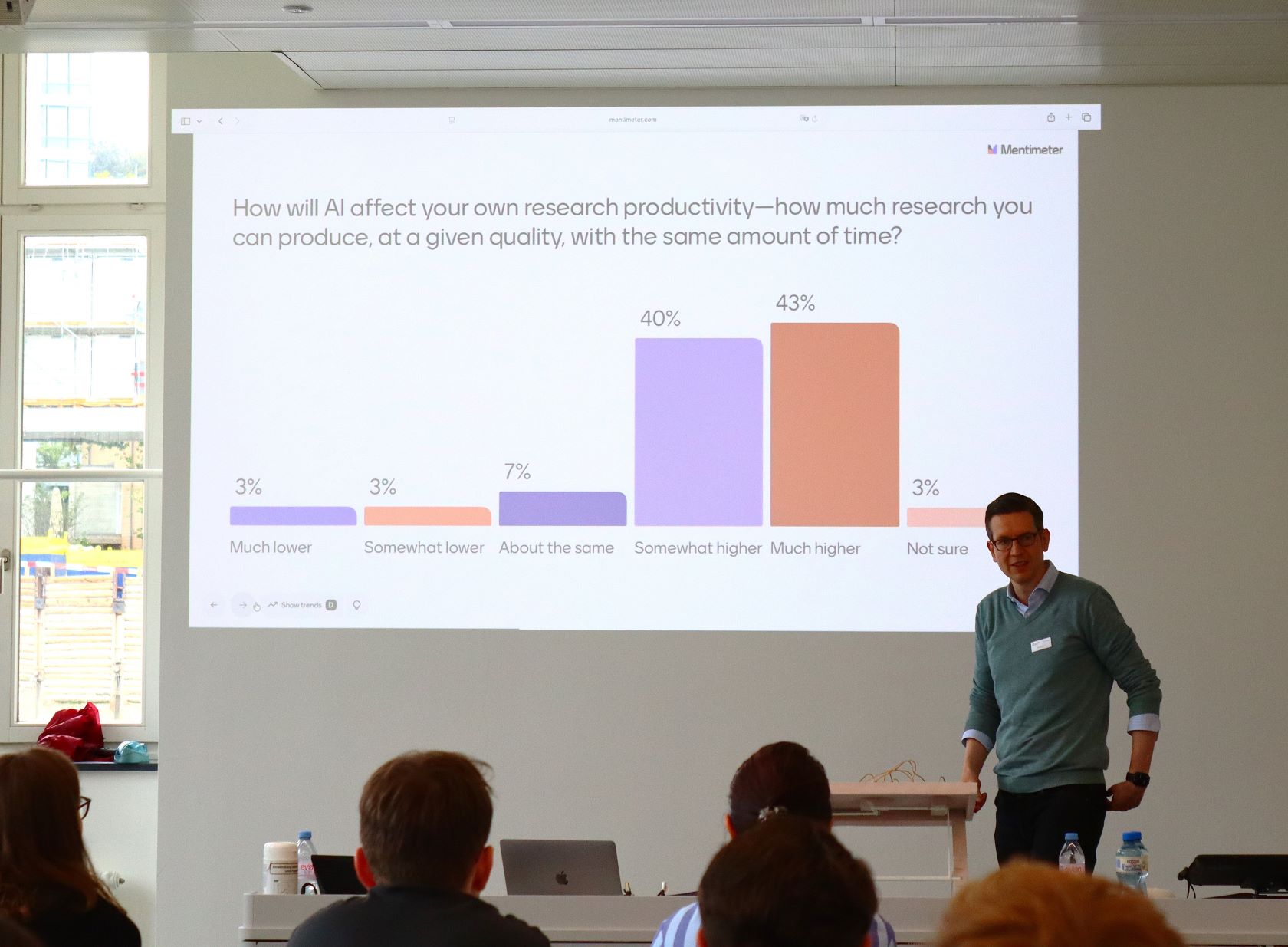
AI is already influencing almost every part of finance research: reviewing literature, working with data, writing and checking code, exploring alternative analyses, and helping with drafting papers. That of course creates opportunities: more researchers can take on ambitious questions, and we can spend less time on tedious routine work. AI can also help us find and avoid errors, and more easily check how sensitive a result is to assumptions and choices in the analysis.
At the same time, easier production does not automatically mean more reliable evidence. In empirical finance, our findings can depend on many choices about data and specifications. A worry is that AI makes it cheaper to search across those choices and then tell a convincing story about the result that happens to “work.” Also, if many more papers are produced, deciding what deserves attention becomes an even bigger challenge than it already is. I think academic journals, conferences and also PhD committees will have to adapt the ways in which research is evaluated.
Your career included both academic research and roles at the Federal Reserve Bank of New York and the Swiss National Bank (where you still serve as a part-time research advisor). How have these experiences shaped the way you approach academic research, and what role does the exchange between academia and policy institutions play in your work?

Spending time in a policy institution is great for researchers because one learns a lot about how certain markets work and how policy affects them.
For instance, at the NY Fed, I was able to work quite closely with the Markets Desk that was implementing the Fed’s purchases of mortgage-backed securities, and so I got insights into the functioning of that market that would be hard to get from textbooks alone. It’s also a great place to generate research ideas: policy decisions often have to be made at short notice, but they still benefit from the deeper analysis that academic research can provide. So knowing what questions policymakers would like answers to, together with that institutional knowledge, can help researchers find fruitful topics and contribute directly to policy discussions.
As you join the University of Zurich, what are you looking forward to, and what would you like to explore or develop in your research and teaching at the Department of Finance?
I’m very much looking forward to interacting with my new colleagues and the students at different levels. We educate a large number of students, many of whom will go on to work in the Swiss financial sector, so helping them understand the financial system and prepare for their future roles is an important part of the job.
I’m also very excited to work with our PhD students and help them do the best possible research.
My teaching will focus on banking-related topics. I’d like students to understand how banks work, why their decisions matter for households and firms, and what the main trade-offs are in regulating them. Since these questions keep evolving - just think about the recent debates about regulation - preparing my courses will also be a good commitment device for me to keep up with the latest policy discussions and research.
Finally, as for new directions in research, I hope to work more with Swiss data. These data have historically been harder for researchers to access than in some other countries, but I’m hopeful that we can build more collaborations with financial institutions and use their data to generate policy-relevant insights.
Thank you very much for taking the time to share your insights with us. We are looking forward to keeping up the conversation with you and wish you all the best for your start!
More information:
|