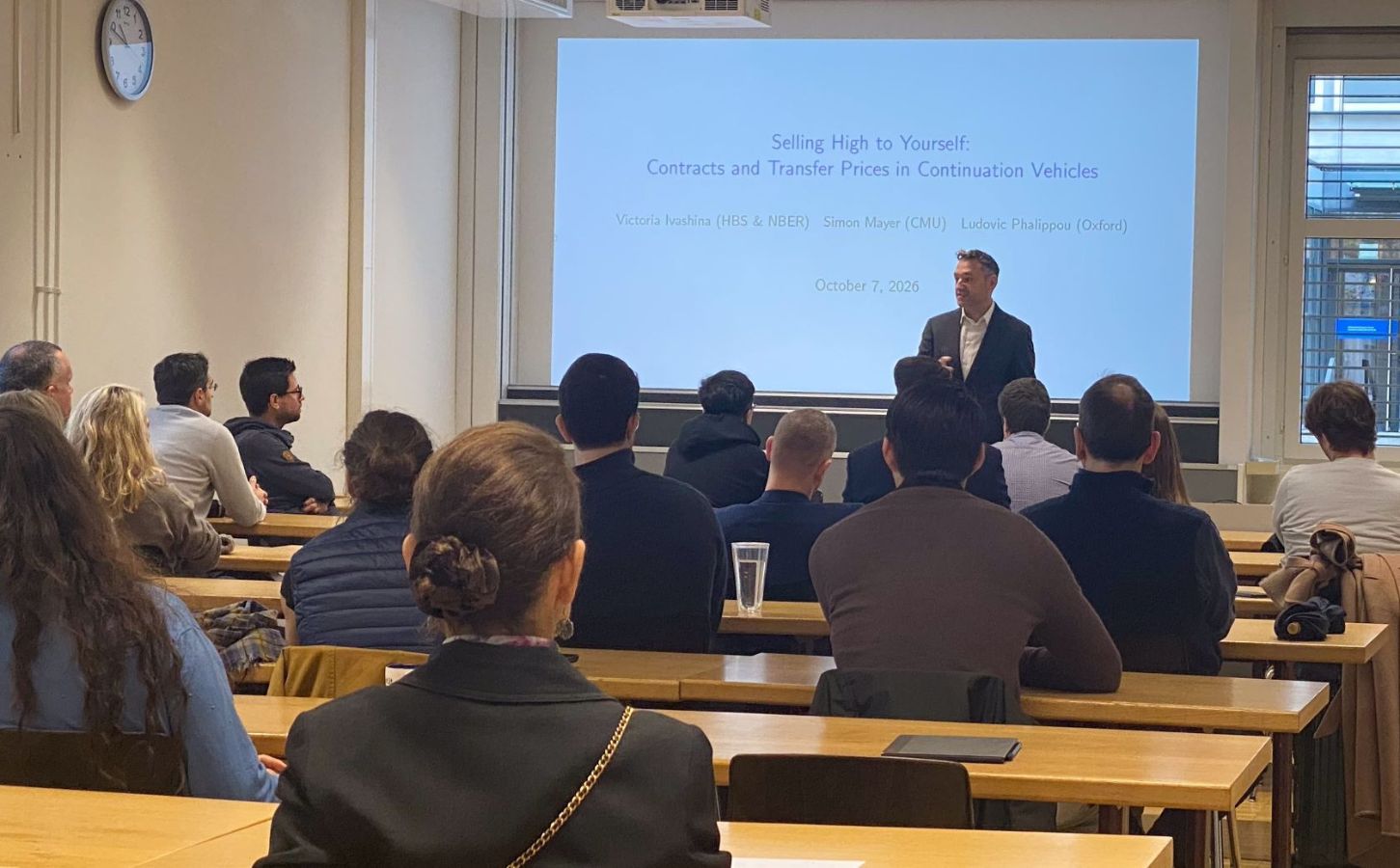
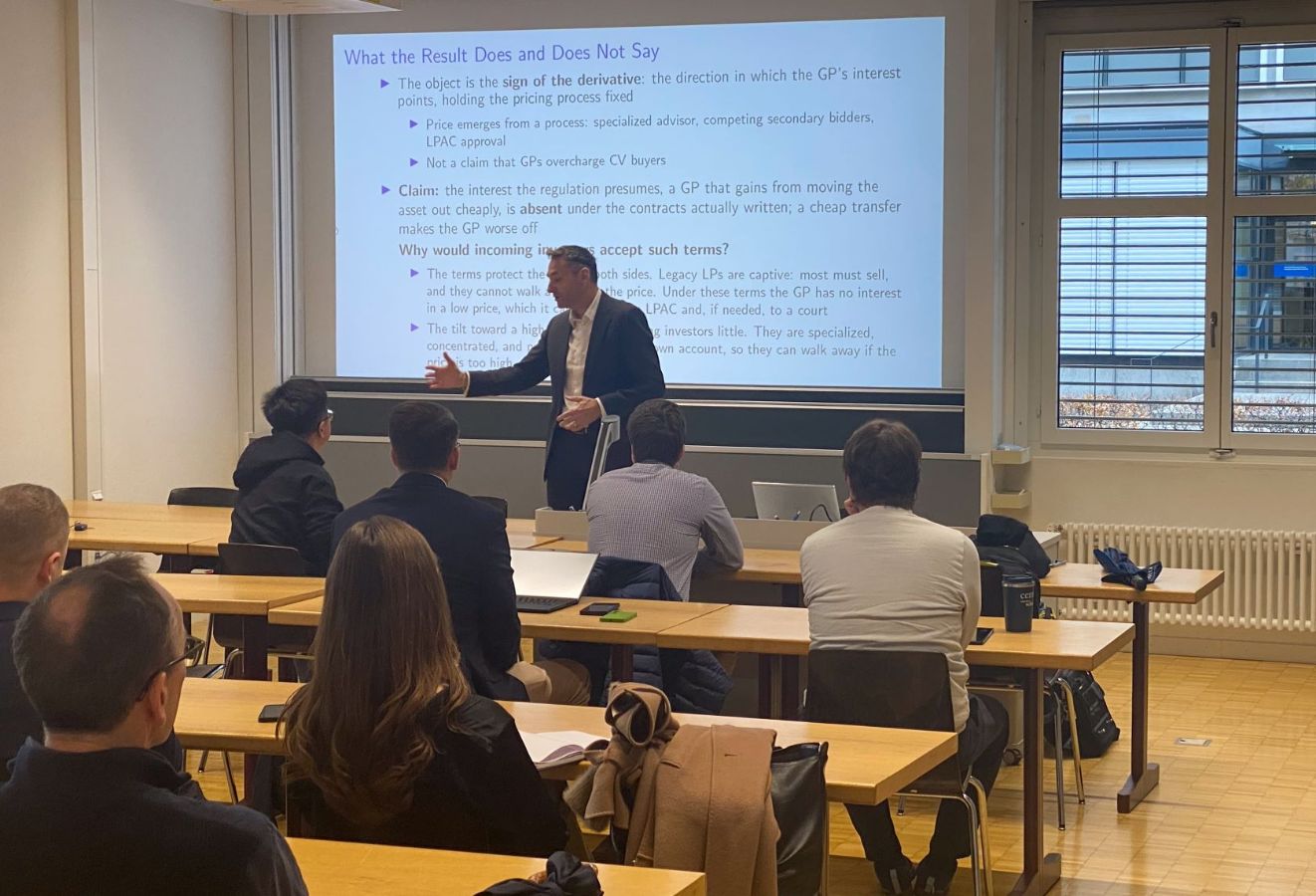
Finance Seminar with Prof. Ludovic Phalippou, Saïd Business School, University of Oxford
"Private Equity Continuation Vehicles: A Model of Strategic Asset Transfers"
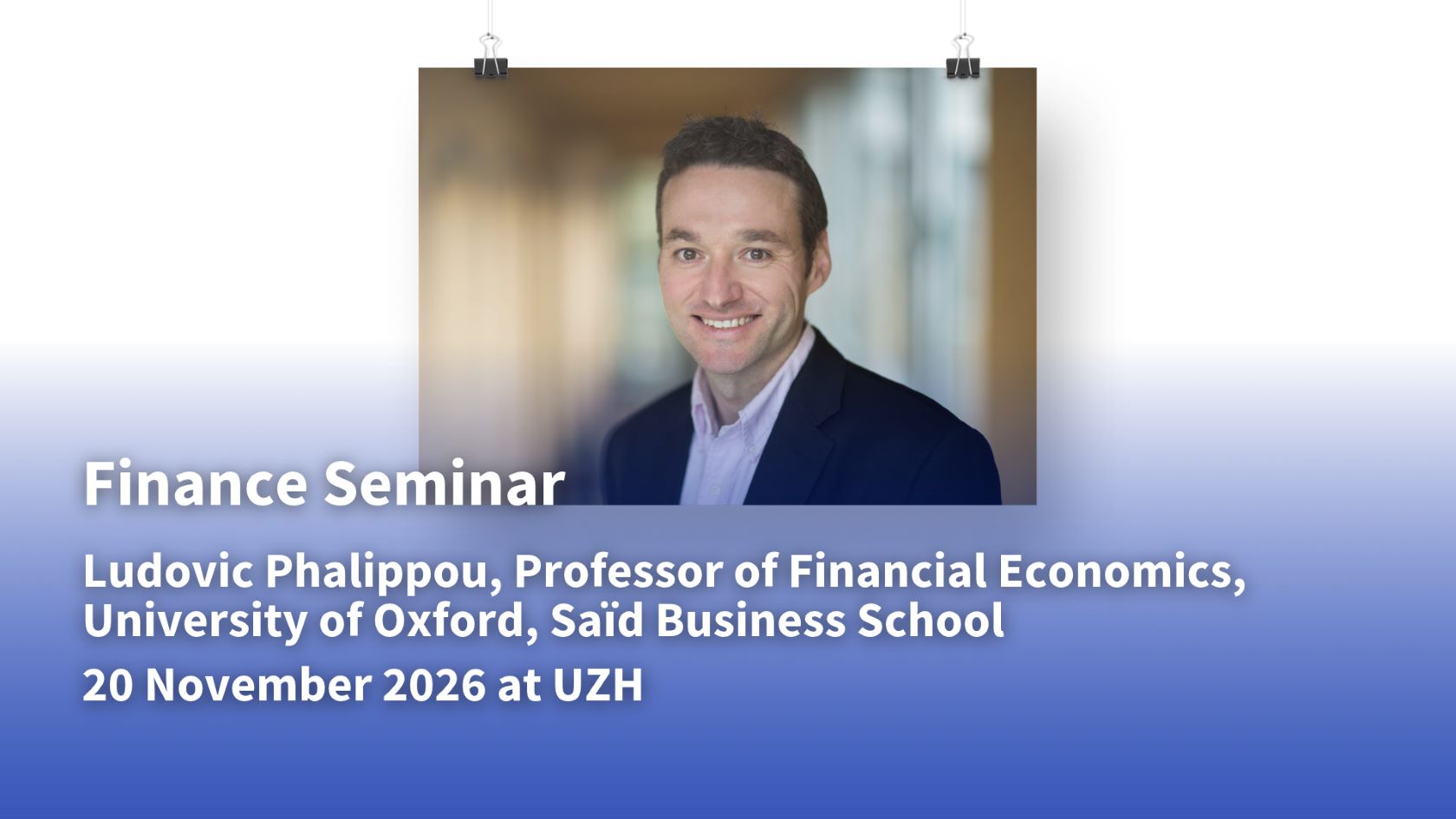
Ludovic Phalippou is Professor of Financial Economics at Saïd Business School, University of Oxford. His research specializes in private market investments, with a focus on tracking fees, aligning interests, and benchmarking returns.
Finance Seminar
|
|
At one of our weekly finance seminars, Prof. Ludovic Phalippou presented and discussed the findings of his research:
|
|
Title: "Private Equity Continuation Vehicles: A Model of Strategic Asset Transfers" Abstract: We develop a framework examining conflicts of interest in continuation vehicles (CVs), where general partners (GPs) transfer portfolio companies from legacy funds to new vehicles they continue to manage. While CVs can extend the holding period of promising firms, they also create opportunities for rent extraction due to GPs’ informational advantage. Two frictions arise: adverse selection, disadvantaging new limited partners (LPs), and inverse selection, disadvantaging exiting legacy LPs. Which dominates depends on the GP’s financial alignment with each fund. We characterize the optimal contract, showing that CV carry is reinvested, legacy-fund compensation is steeper, and single-asset CVs emerge optimally. Proprietary transaction data provide systematic evidence on CV contractual features. Ivashina, Victoria and Mayer, Simon and Phalippou, Ludovic, Private Equity Continuation Vehicles: A Model of Strategic Asset Transfers (August 21, 2025). Available at SSRN: https://ssrn.com/abstract=5400386 or http://dx.doi.org/10.2139/ssrn.5400386 |

Research. Self. Tomorrow.
Dear Prof. Phalippou,
Thank you very much for your presentation at our department. To help us get to know the person behind the research a little better, we’ve prepared three questions for you, and we’re looking forward to hearing your answers: Research. Self. Tomorrow.
What comes to your mind?
- Research
What are the main conflicts of interest that can arise when private equity firms transfer companies from one investment fund to another?At the seminar, I presented two related papers on continuation vehicles, written with Victoria Ivashina (Harvard) and Simon Mayer (Carnegie Mellon). A private equity manager raises money from investors such as pension funds, buys companies, and normally sells each one to an outside buyer after about five years. In a continuation vehicle, the manager instead sells a company to a new fund that it also manages, financed by new investors. The manager therefore stands on both sides of the sale. These deals have tripled in volume since 2021 and accounted for about 14% of private equity exits in 2025.
Regulators and investor groups have mostly worried that the manager sells too cheaply, at the expense of the investors in the original fund. The paper I focused on in the seminar collects the contracts used in these deals and shows that they push the other way. In the original fund, the manager typically keeps 20% of the profits. In the new vehicle, its share starts at 10% and rises in steps to 25% only if returns are high. A higher sale price raises the profit booked in the original fund, of which the manager keeps 20%, and lowers future profits in the new vehicle, of which it keeps less. The manager therefore earns more by overpricing, and the risk falls on the buyers. The companion paper shows that a fair price does not settle every problem. Because the manager decides which companies to keep rather than sell, it could keep some that should be sold. Investors must then pay the manager more, and in a different form, to make it keep only the right ones.
- Personal
What sparked your interest in researching private equity and the complex decisions behind these transactions?
During my PhD at INSEAD, a fellow student who had worked as a consultant showed me data on private equity funds. When I then read the funds' marketing documents and contracts, I was shocked. The marketing documents used tricks that made performance look much better than it was, and the contracts let the manager do almost anything it wanted. Continuation vehicles are the latest example of that freedom. Investors commit to a fund on the understanding that the manager will buy companies and sell each one to an outside buyer after about five years. With a continuation vehicle, the manager can decide instead to sell a company to a new fund it manages, financed by a specialist buyer, and invest in that new fund itself. - Tomorrow
How could your findings help make continuation vehicle transactions more transparent and better align the interests of investors and fund managers?
Today, oversight focuses on whether the sale price is fair. The usual check is a fairness opinion, a report in which an outside adviser confirms the price. Our findings suggest that the price is less of a worry than commonly thought. Under the standard contract, the manager gains from a high price, so its interests are aligned with those of the investors who sell. The buyers bear more of the risk, but they are specialist investors who set the price through negotiation. The sellers are mainly at risk if the manager strikes a side deal with the lead buyer, so transparency should cover any arrangements between the two. The larger issue is the manager's power to choose which companies to keep. Even when every price is fair, that power forces investors to raise and restructure the manager's pay so that it keeps only the companies worth keeping. Investors should weigh this cost when they agree to these transactions. A simple solution is to ban continuation in the initial contracts if they feel that the cost overweight the benefits.
More information and impressions:
|