"Beyond Exposure: How Firms Adapt to Climate Risk"
Interview with Tobias Schimanski, PhD Candidate at our UZH Department of Finance

Tobias Schimanski is a PhD candidate at our department, focusing on NLP for Sustainable Finance and ClimateNLP, supervised by Prof. Markus Leippold.
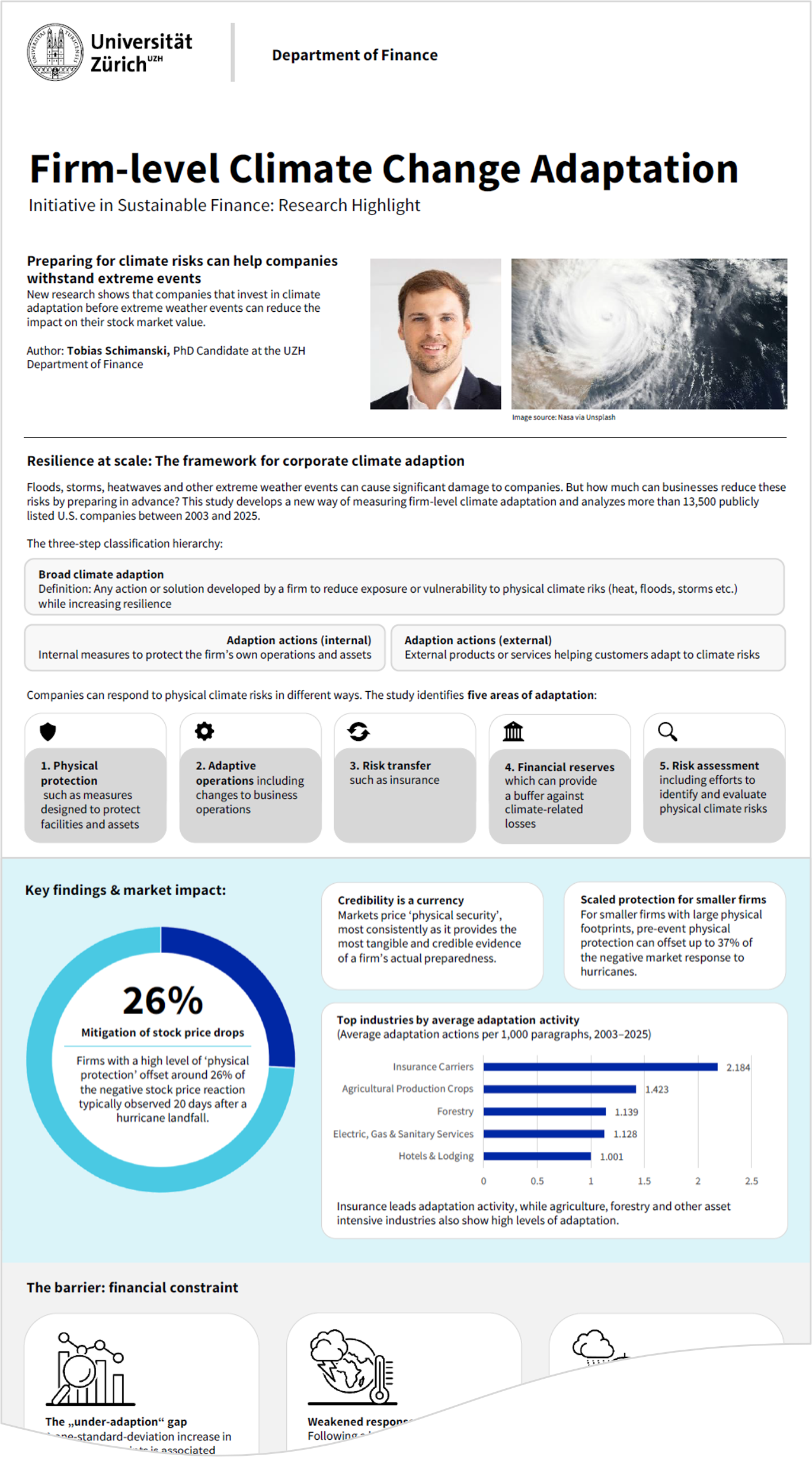
Tobias recently published a paper titled "Firm-level Climate Change Adaptation", where he examines how companies adapt to physical climate risks and whether these efforts can protect them when extreme weather strikes. The study develops a new way of measuring firm-level climate adaptation and analyzes more than 13,500 publicly listed U.S. companies between 2003 and 2025.
This finding is important because much of the discussion around corporate climate risk focuses on exposure: Which companies are located in areas vulnerable to floods, storms or other hazards? This study shifts the focus to a different question: What are companies actually doing to prepare for these risks?
I had the pleasure of speaking with Tobias about his research, what motivated him to pursue it, and his broader perspective on the future.

Interview
Dear Tobias, you have developed a method that identifies climate change adaptation actions and solutions of firms. What motivated you to explore this topic, and how did you arrive at your research question?
I think that the overall picture is evident: We, as a world, seem to not be successful in reaching climate goals. This means, we will face increasing amounts of extreme weather events. Current literature focuses on understanding who is exposed or impacted by extreme weather. However, there is very little known in how firms adapt to physical climate risk.
This paper aims to close this gap and explores what role adaptation plays when an event hits. It also outlines driving forces, or rather hindering forces of adaptation - namely firm's financial constraints. This may result in a systemic risk in the future; a matter policy makers may want to address rather sooner than later.
Your approach relies on LLM based text classification: where do you see the main advantages and the main limitations of this method compared to traditional keyword-based approaches?
I my opinion, the right nail needs the right hammer. General climate talk can often be successfully detected with keywords. Adaptation, however, is very context-sensitive. Firms can express their adaptation actions and solutions in various ways. And LLMs are very good in understanding context. Hence, LLMs are more precise. This is especially valuable because I move away from just "adaptation" but also go into "actions" and "solutions" as well as five subcategories of "actions" (physical protection, adaptive operations, risk transfer, financial reserves, risk assessment). The more fine-grained the definition, the more LLMs can help with context-sensitive understanding.
In the paper, I also compare my approach to pre-defined keywords and keyword discovery algorithms, showing superiority of an LLM-based classifier in this setting. In the paper, I explore the differences in more detail.
Your results show that physical protection measures ahead of hurricanes substantially mitigate negative stock market reactions. Which concrete measures do you most frequently observe in the 10 K reports?

Yes, indeed physical protection does mitigate negative stock market reactions ahead of events.
However, I argue, it is mainly about credibility and therefore firm characteristics. For the average firm, physical protection seems to be credible in case of an event because it may be the narrowest and easiest to understand form of adaptation. After all, building a floodwall or hardening buildings is a very strong commitment and requires some level of understanding.
However, for different firms, different adaptation measures seem credible. For example, for firms with higher past physical climate risk exposure, hence more scrutinized firms, pre-event communication about adaptative operations, risk transfers (e.g., insurance) and risk assessments also helps mitigate negative stock market reactions. The latter category of risk assessment is also the most frequent measure of adaptation that I observe. I think being "aware" is a starting point. On the other hand, physical protection is the least frequently observed measure of adaptation.
You find that financial constraints significantly dampen firms’ ability to adapt. In your view, what role should policymakers and regulators play in addressing these frictions?
So, first, I think this finding is logically sound: firms facing financial constraints adapt both before an event and once they are exposed to actual events, while firms without financial constraints show signs of adaptation only after exposure. This is also priced in markets, where firms with financial constraints do not experience significant mitigation of negative impacts.
What is the challenge here? If we go forward with increasing physical risks, then these already constrained firms may suffer disproportionally, possibly to the extent of bankruptcy. With the wildfire-induced bankruptcy of California's largest utility, Pacific Gas and Electric Company (PG&E), we have already seen a precedent of what could happen more widely in the future (The Wall Street Journal: PG&E - The First Climate-Change Bankruptcy, Probably Not the Last). Policy makers may want to ease dedicated investment into adaptation or redirect some of the catastrophe recovery spending into adaptation and resilience. In my eyes, this debate is currently too small because there is, for good reasons, much more focus on climate transition (or like in the US, no climate discussion at all anymore).
The Wall Street Journal: PG&E - The First Climate-Change Bankruptcy, Probably Not the Last (2019) https://www.wsj.com/articles/pg-e-wildfires-and-the-first-climate-change-bankruptcy-11547820006
How do adaptation strategies differ between highly physically exposed sectors (such as utilities or agriculture) and more service-oriented sectors like insurance?
This exact answer to this question, especially with time trends, lies in the data that I have made public with the paper. What I can see for now is that firms in physically exposed sectors like forestry, agriculture, electric and gas services are most prominent across all adaptation categories, specifically though physical protection and adaptative operations. More service-orientated sectors like insurance use more financial mechanisms like risk transfers or financial reserves. More generally, historical engagement with adaptation is a matter of industry belongingness.
However, I see a clear spike in adaptation across all sectors in recent years, specifically pronounced increases in 2025. Maybe, firms also realize that with no climate transition risk, the world is headed towards physical climate risk. Detailed investigations on that matter are possible with the method and data, but a topic of future research.
What are your next research steps based on this dataset? For example, towards international comparisons, other climate risks, or integrating the measures into portfolio models for investors?
Good question. The field is wide and widely unexplored. I think one of the reasons is that physical climate risk affects firms in heterogeneous ways - physical footprint, geography, and business models - all play a role. My idea is to use the data and look at the effects on fundamentals. At the same time, another question is what makes communication about adaptation credible and how investors can learn more effectively about firms' adaptation.
Where do you see the world heading, and how would you like your research to contribute to a better future?
Where does the world lead to? I still hope that we can avoid the most catastrophic consequences of climate change. However, I think it will become reality to face and deal with these risks. I hope that adaptation will not only be treated as an idiosyncratic problem of individual firms, but that we can go towards a more holistic approach in adapting to these risks. Studying adaptation world-wide would be important since the effects of climate change affect nations with higher financial constraints disproportionately.
Thank you for taking the time to share your research, your perspective and your vision with us!
More information:
|