Finance Seminar Interview with Christine Laudenbach, Leibniz Institute for Financial Research SAFE
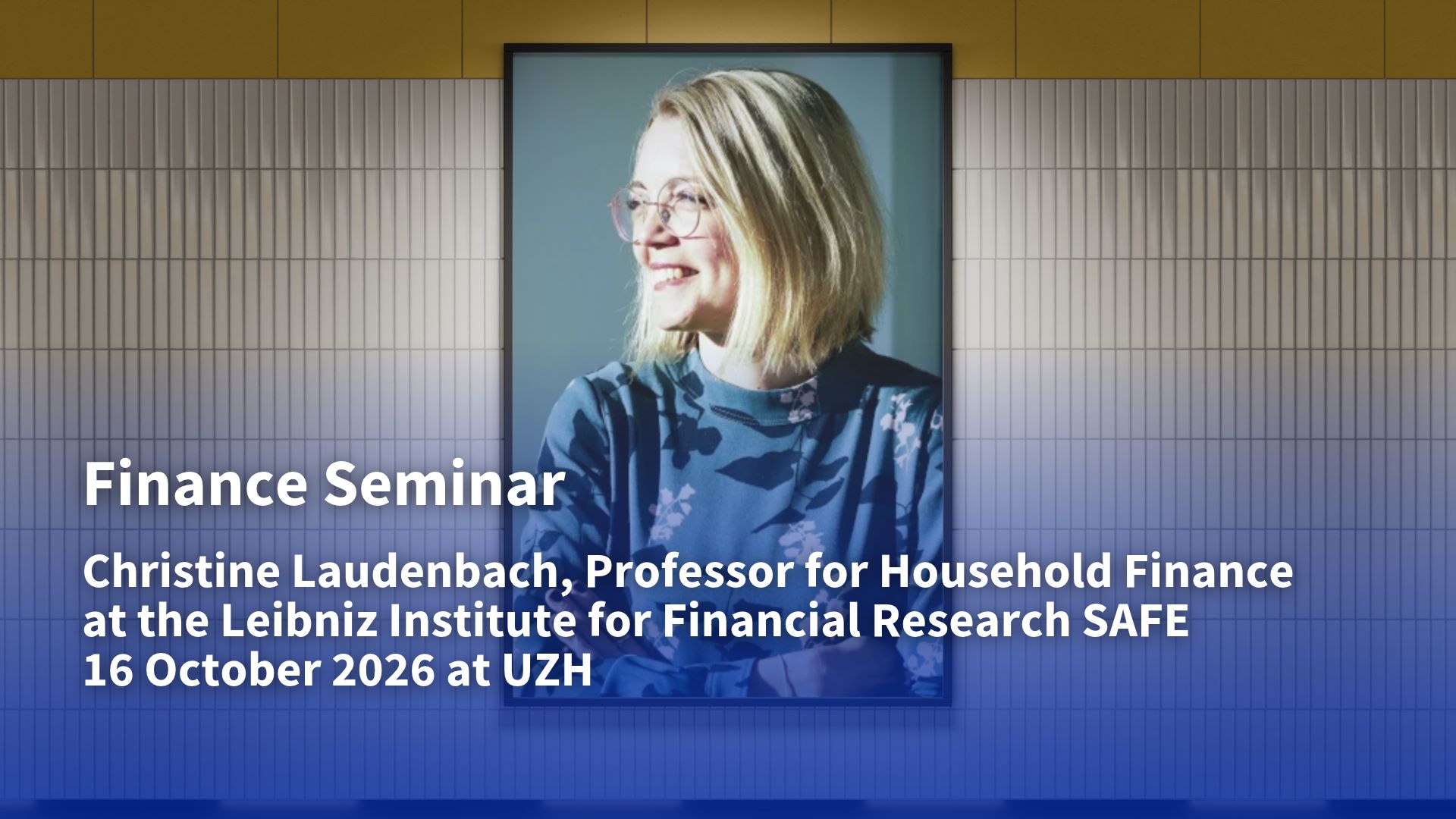
Christine Laudenbach is a Professor of Finance at Goethe University and Director of the Household Finance Department at the Leibniz Institute for Financial Research SAFE in Frankfurt, as well as a CEPR Research Fellow. Her research explores behavioral economics and household finance, with a focus on understanding financial decision-making among private households and identifying ways to support better financial choices through education, regulation, financial advice, and practical tools.
Finance Seminar
|
|
On Friday, 2 October 2026, Prof. Christine Laudenbach presented and discussed his research findings at our weekly Finance Seminar:
|
|
Title: "Trading Narratives" Abstract: We study how investors cognitively represent their investment experience by eliciting open-text narratives about their stock trades in a survey of retail investors and linking them to administrative transaction records. We find that investors disproportionately retrieve stock purchases rather than sales from memory, a pattern largely organized by which positions they still hold. Retrieved purchases and sales are, in turn, represented through systematically different narratives: purchase narratives emphasize company fundamentals and are forward-looking, whereas sale narratives emphasize prices and trading rules and are backward-looking. These representations are not static: as outcomes unfold, investors selectively reconstruct their narratives in ways that justify the original decision. Finally, these representations carry over to beliefs and behavior: which trades investors recall predicts their overconfidence, and their narrative types predict trading styles and the informativeness of their trades. Overall, we show that how experience shapes beliefs and behavior depends not only on what investors experience, but on how they represent it. |

Research. Self. Tomorrow.
Dear Prof. Laudenbach,
Thank you very much for visiting our department, as well as for your engaging presentation! To help us get to know the person behind the research a little better, we have three keywords for you: Research. Self. Tomorrow.
What comes to your mind?
- Research
When we asked retail investors to describe in their own words why they bought or sold a particular stock and then matched those accounts with their actual transaction records, a clear pattern emerged. Purchases are recalled more readily than sales, and the two are represented in fundamentally different ways. Purchase narratives tend to emphasize company fundamentals and are forward-looking: investors seem to describe the case for an ongoing investment. Sale narratives are more backward-looking and episodic, focused on prices, trading rules, and transaction mechanics. They read like a record of something completed.
And interestingly, these narratives shift over time. Ten months later, investors had rewritten their accounts in ways that were conveniently consistent with how the trade turned out: retaining justifications that remained defensible, dropping the ones that didn’t. It’s selective reconstruction. And it matters for beliefs and trading behavior.
- Self
We all know the experience: two people remember the same conversation completely differently, whether it was an argument or just a chat. We see it in eyewitness testimony too. So why would financial decisions be any different.
Maybe because we tend to think of finance as the domain where this shouldn’t matter: it’s all numbers, and numbers are clear.
Early in my career, a colleague showed me a fascinating scatter plot: on one axis, what investors reported their portfolio return had been over the past year; on the other, what it actually was. The correlation was close to zero. Whether people suppress, embellish, or simply never encode the information accurately, that’s what I wanted to understand better.
- Tomorrow
That’s s good question, that I cannot fully answer right now. What we do see is that selective memory shapes future decisions: which trades come to mind predicts overconfidence, and the narratives investors tell predict how they trade next. Whether this is good or bad and for whom is exactly what we’re trying to understand better.
More information and impressions:
|
-
 Francisco Amaral and Christine Laudenbach
-
.jpg/jcr:content/Finance%20Seminar_Christine%20Laudenbach_20261016_1%20(1).jpg 900h) Prof. Laudenbach presenting at the Finance Seminar